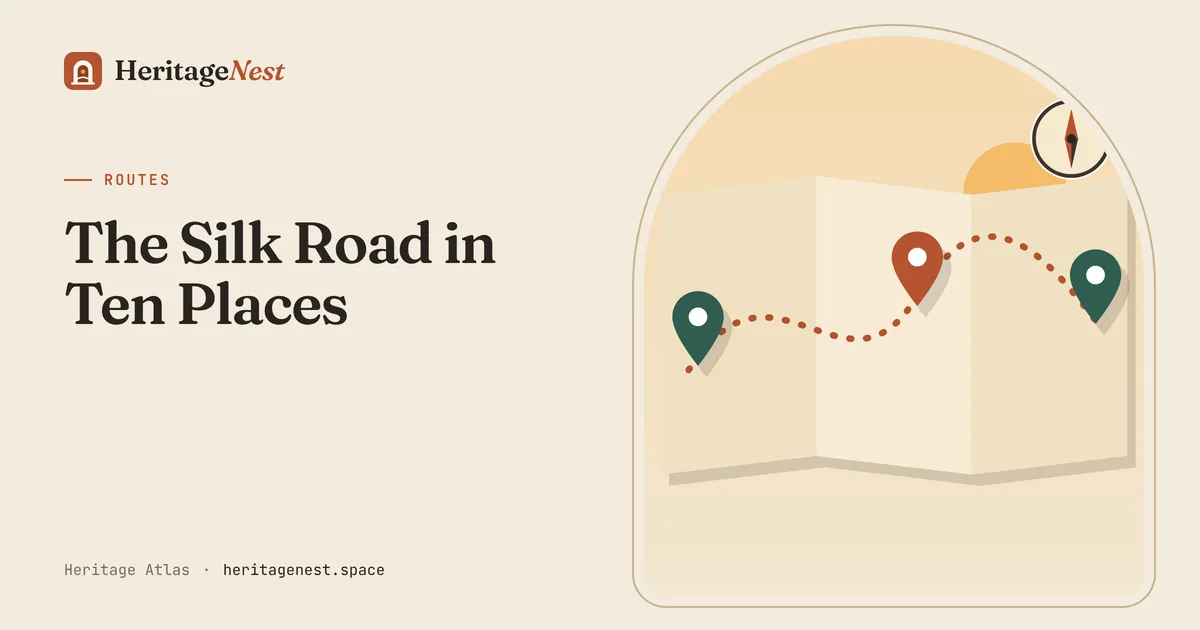
There was never a single “Silk Road”. The name was coined in 1877 by the German geographer Ferdinand von Richthofen for a web of overland routes that linked China with Central Asia, South Asia, Iran and the Mediterranean. Silk travelled along them, but so did horses, glass, spices, paper, religions, music and diseases.
The routes took shape after the Chinese envoy Zhang Qian travelled west in the second century BCE, and they stayed busy for well over a thousand years. Here are ten places that bring the story to life.
1. Xi’an, China
As Chang’an, Xi’an was the capital of the Han and Tang dynasties and the eastern starting point of many caravans. Just outside the city lies the Terracotta Army of the first emperor, Qin Shi Huang.
2. Dunhuang, China
At the edge of the desert, Dunhuang was the last major oasis before the routes split around the Taklamakan. The Mogao Caves nearby hold hundreds of painted Buddhist cave temples, and a sealed “library cave” held tens of thousands of manuscripts, including a printed copy of the Diamond Sutra dated 868 CE.
3. Turpan, China
In a deep, hot basin, Turpan grew grapes and cotton thanks to underground irrigation channels called karez. The ruined city of Jiaohe, carved into a clay plateau between two rivers, sits just outside town.
4. Kashgar, China
Kashgar was where the northern and southern routes around the Taklamakan met before crossing the mountains into Central Asia. For centuries its markets have drawn traders from every direction.
5. Taxila, Pakistan
Branch routes led south through the mountains into Gandhara. Taxila was a crossroads of trade and learning, and its monasteries show how Buddhism and art travelled between South Asia and Central Asia along these networks.
6. Samarkand, Uzbekistan
Samarkand was the great city of the Sogdians, the merchants who dominated Silk Road trade for centuries. Its famous Registan square is later, built under the Timurids and their successors, but it stands on very old commercial ground.
7. Bukhara, Uzbekistan
Bukhara’s old town still has covered trading domes where merchants once met. The tenth-century Samanid Mausoleum, made of patterned brick, is one of the oldest Islamic monuments in Central Asia.
8. Merv, Turkmenistan
Merv was one of the great oasis cities of Central Asia and, by the twelfth century, one of the largest cities in the world. Its ruins cover several successive walled cities built over more than two thousand years.
9. Palmyra, Syria
In the Syrian desert, Palmyra grew rich on caravans in the first to third centuries CE, blending Greek, Roman, Persian and local traditions in its temples and colonnaded streets. Parts of the site were deliberately destroyed during the war in 2015.
10. Istanbul, Türkiye
As Constantinople, the city was a western end of the routes and a great market for silk. In the sixth century, under Emperor Justinian, silkworm eggs were smuggled into the Byzantine Empire, and silk production began in the West.
Seeing the Silk Road today
In 2014 UNESCO inscribed a long section of the eastern routes, the Chang’an–Tianshan corridor, as a World Heritage Site shared by China, Kazakhstan and Kyrgyzstan. Most travellers pick one region — western China, Uzbekistan or the Pakistani stretch through Gandhara — rather than trying to follow the whole network. Spring and autumn avoid the worst of the desert heat and mountain cold.
Questions readers ask
Who named the Silk Road?
Was the Silk Road a single road?
Does the Silk Road pass through Pakistan?
Sites in this article