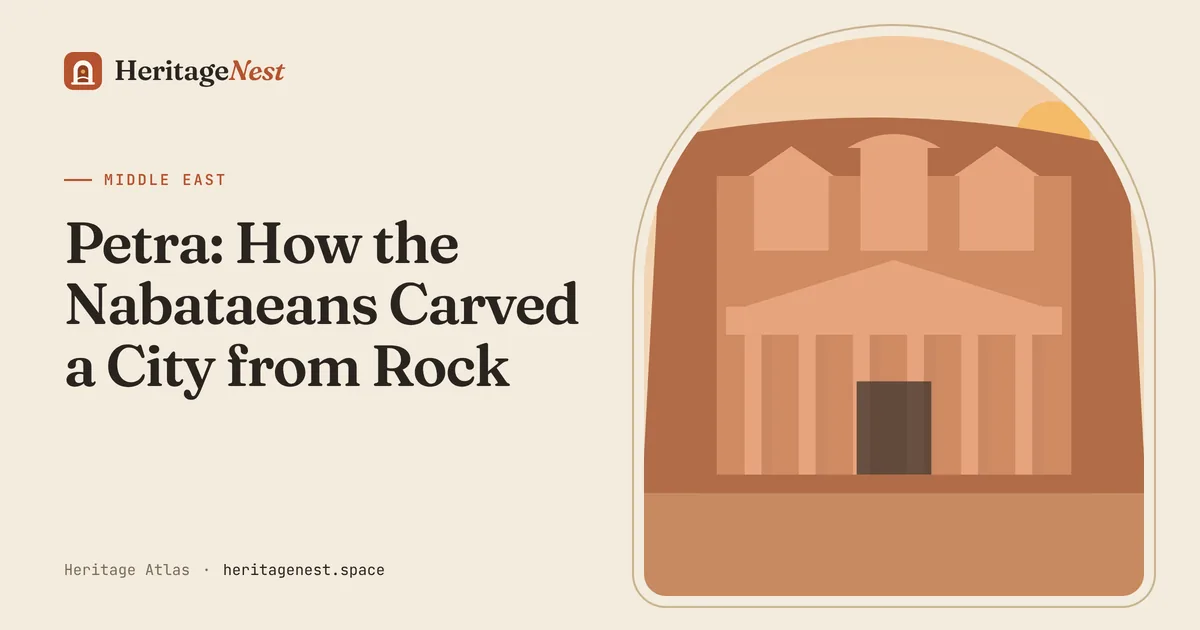
Petra is famous for what looks like architecture but is really sculpture. Its great facades were not built from blocks — they were cut straight into the sandstone cliffs of southern Jordan by the Nabataeans, Arab traders who grew rich on the caravan routes that carried incense and spices from Arabia to the Mediterranean.
Who were the Nabataeans?
The Nabataeans began as nomadic people of the desert and became the middlemen of a lucrative trade. Petra, hidden among mountains and reached through narrow gorges, became their capital. It flourished especially from the first century BCE to the first century CE, when its rulers minted coins and built on a grand scale.
Carved from the top down
Unfinished facades around Petra show how the work was done. Masons started at the top of the cliff, cutting a flat face and carving details as they worked downwards, so they never needed scaffolding below the finished work. Mistakes could not be undone, which makes the precision of the best facades remarkable.
The most famous of them, al-Khazneh — “the Treasury” — got its name from a legend of hidden pirate gold. It was most likely a royal tomb, often dated to the reign of King Aretas IV around the turn of the era. Its design mixes Greek, Egyptian and local Nabataean styles, a sign of how connected Petra was.
Mastering water
The real engineering achievement of Petra is less visible. The city sits in a dry landscape that can suddenly flood after rain. The Nabataeans built dams to divert flash floods away from the main gorge, channels and clay pipes to bring water from springs, and cisterns to store it through the dry season.
Petra’s monuments are carved in stone, but the city survived on its water.
More than tombs
Most of the carved facades were tombs, but Petra was a living city with free-standing temples, a colonnaded street, markets, houses and a theatre cut into the rock. Many of the built structures have collapsed, which is why the carved facades dominate the view today.
Decline and rediscovery
In 106 CE the Romans annexed the Nabataean kingdom, and trade routes gradually shifted. A major earthquake in 363 CE damaged much of the city. Petra was never entirely empty — local Bedouin knew it well — but it faded from European knowledge until the Swiss traveller Johann Ludwig Burckhardt reached it in disguise in 1812. It became a UNESCO World Heritage Site in 1985.
Visiting
Enter through the Siq, the narrow gorge leading to the Treasury, early in the morning before the crowds arrive. Save energy for the climb of about 800 steps to Ad-Deir, the Monastery, one of the largest facades in Petra. Spring and autumn are the most comfortable seasons. Read more in our Petra site guide.
Questions readers ask
Who built Petra?
How were Petra’s facades carved?
What was the Treasury at Petra?
Sites in this article