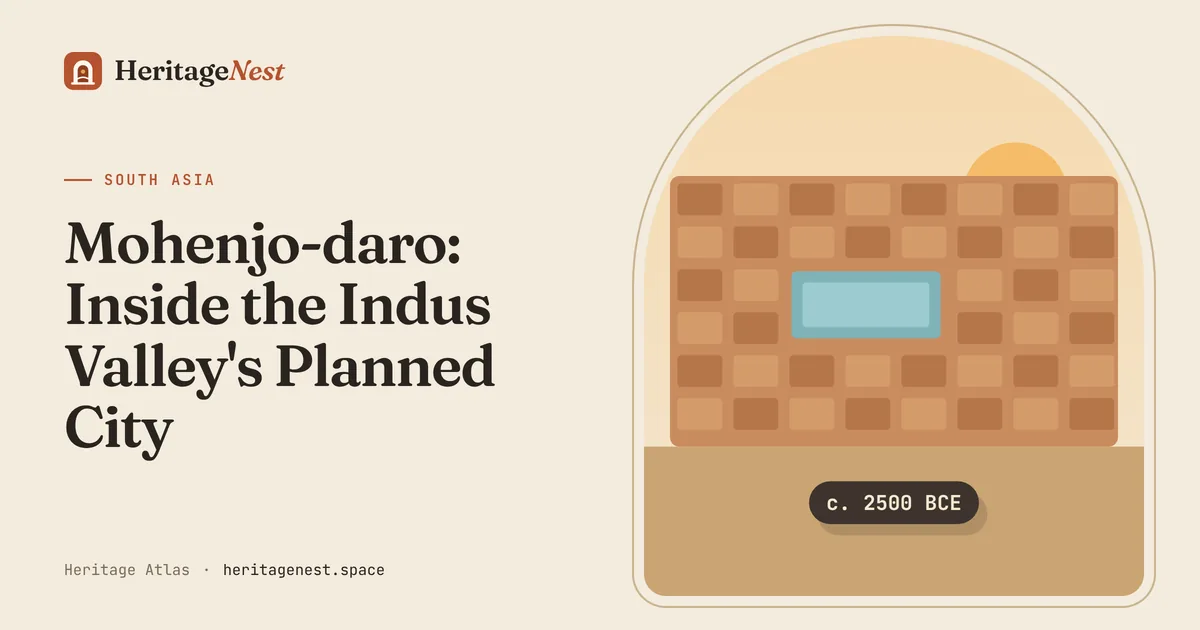
Stand on the main street of Mohenjo-daro and the first thing you notice is how straight it is. Around 2500 BCE, on the banks of the Indus in what is now Sindh, people laid out a city with a grid of streets, covered drains and houses built from bricks of a standard size. Few places of the Bronze Age show town planning on this scale.
Mohenjo-daro was one of the largest cities of the Indus Valley Civilisation, which flourished in its mature phase from about 2600 to 1900 BCE across what is now Pakistan and north-west India. Its name is usually translated from Sindhi as “mound of the dead”.
Two mounds, one plan
The city sits on two main mounds. The higher western mound, often called the citadel, was built up on a massive brick platform that raised its buildings above flood level. The larger eastern mound held the lower town, where most people lived and worked.
The citadel holds the city’s most famous structures: the Great Bath, a large building often described as a granary or hall, and other public buildings. On top of it stands a much later Buddhist stupa, built around two thousand years after the city was abandoned — a reminder that a site can have more than one life.
The Great Bath
The Great Bath is a rectangular pool about 12 metres long, 7 metres wide and 2.4 metres deep, reached by steps at each end. Its fitted bricks were set in gypsum mortar and backed with a layer of bitumen to keep the water in, and a drain could empty it.
No text tells us what it was for. Most archaeologists see it as a place for ritual bathing, an early example of water playing a role in public religious life in South Asia.
Streets, drains and wells
The lower town was divided into blocks by main streets running roughly north–south and east–west, with narrower lanes between them. Many houses were built around courtyards and had their own bathing areas, which drained into brick-lined channels running along the streets. Those channels were covered and had inspection points for cleaning.
Water came from wells. Hundreds of brick-lined wells have been recorded across the site, enough that many households would have had one nearby. Few ancient cities offered this kind of everyday access to clean water.
Mohenjo-daro has no grand palace and no royal tombs — its monuments are its drains, its wells and its streets.
A city of standards
Indus bricks were made in a consistent ratio of thickness to width to length of about 1:2:4, at Mohenjo-daro and at sites hundreds of kilometres away. Stone weights followed a standard system too. Together with the famous carved seals, inscribed in a script that has still not been deciphered, they point to shared rules and widespread trade.
Who set those standards is one of the great open questions. Unlike Egypt or Mesopotamia, the Indus cities show no obvious palaces, no monumental royal tombs and few signs of a single ruler. However the city was governed, it worked.
Rediscovery and conservation
The site was identified in 1922 by R. D. Banerji of the Archaeological Survey of India, and large excavations followed under John Marshall in the 1920s. Famous finds include the bronze Dancing Girl and the stone figure known as the “Priest-King”. Mohenjo-daro became a UNESCO World Heritage Site in 1980.
Today the biggest threat is not looting but salt. Groundwater carries salts into the brick, where they crystallise and crumble it. Much of the conservation work is about protecting what has already been excavated rather than digging more.
Visiting
Mohenjo-daro lies south of Larkana in Sindh, and the cooler months from November to February are the most comfortable time to visit. Allow time for the site museum, then walk the citadel first for the view over the lower town. To see how other Indus cities compare, read our guides to Harappa and the dockyard town of Lothal.
Questions readers ask
How old is Mohenjo-daro?
Why is Mohenjo-daro famous?
Has the Indus script been deciphered?
Sites in this article