Lahore Fort, the Shahi Qila, rises at the north-western corner of the Walled City. People lived on this spot long before the Mughals, but most of what you see today was built by four Mughal emperors over about a hundred years, then reused by the Sikh and British rulers who followed.
Together with the Shalimar Gardens, the fort was inscribed as a UNESCO World Heritage Site in 1981.
Four emperors, four styles
Akbar rebuilt the fort in fired brick from 1566, giving it the massive walls and gateways that defined its shape. Jahangir added palace quarters and began the decoration of the outer walls. Shah Jahan, the emperor who later built the Taj Mahal, added most of the marble pavilions and the Sheesh Mahal. Aurangzeb built the grand Alamgiri Gate in 1674, facing the Badshahi Mosque across the Hazuri Bagh garden.
Walking through the fort is a little like walking through a history of Mughal taste: sturdy red sandstone and brick early on, white marble and fine inlay later.
The Sheesh Mahal
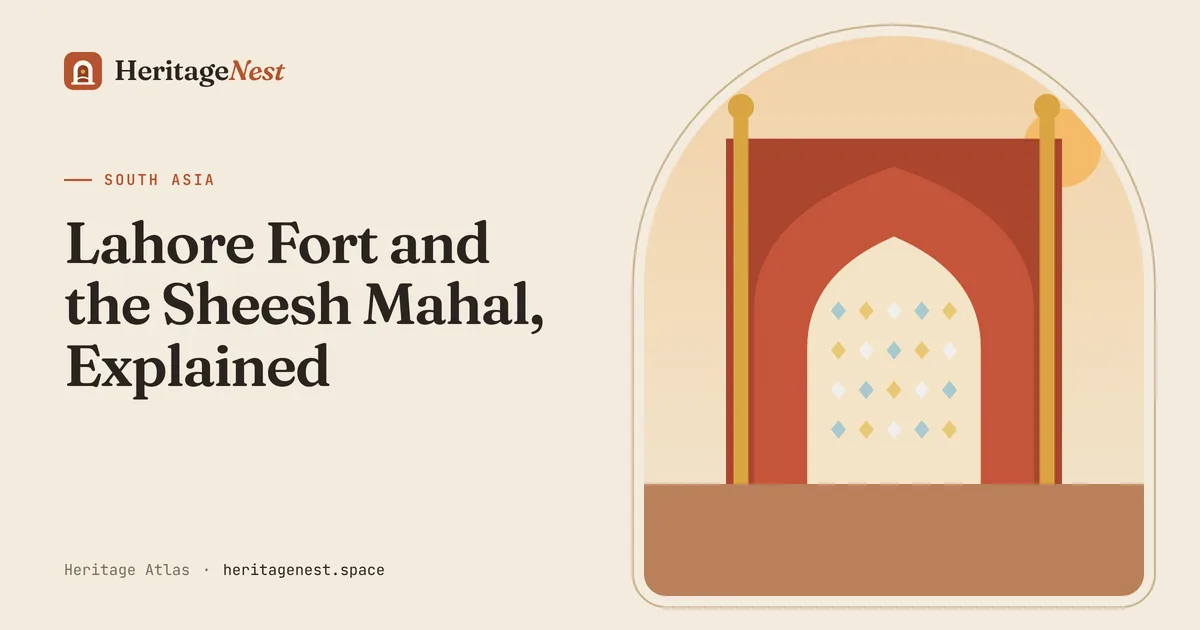
The Sheesh Mahal, or Palace of Mirrors, was built in the early 1630s for Shah Jahan inside the Shah Burj, a private block of the palace. Its walls and ceilings are covered in a mosaic of small pieces of convex mirror glass set into plaster, a technique known as ayina-kari, alongside white marble carved and inlaid with semi-precious stones.
The glass scatters even a small amount of light into countless reflections, which is why guides love to say that a single candle could light the whole hall. It was a private space for the emperor and his household, far from the public audience halls.
The Naulakha Pavilion
Beside the Sheesh Mahal stands the Naulakha, a small marble pavilion with a curved roof borrowed from the architecture of Bengal. Its name is usually explained as “nine lakh”, the sum said to have been spent on it. Look closely at the marble and you will see delicate inlaid flowers.
The Picture Wall
Along the fort’s outer walls runs one of the largest tile murals in the world. Built under Jahangir and Shah Jahan, the Picture Wall stretches for hundreds of metres and is covered in glazed tiles and brick mosaic showing elephant fights, polo matches, hunting scenes, angels and animals.
Centuries of weather damaged it badly. Conservation work by the Walled City of Lahore Authority with the Aga Khan Trust for Culture has been cleaning and stabilising the panels, and it is worth walking the outside of the fort just to see it.
After the Mughals
When Ranjit Singh made Lahore the capital of the Sikh Empire in the early nineteenth century, he used the fort as a royal residence and added buildings of his own. Under British rule it became a military garrison, and some halls were altered. These later layers are part of the fort’s story too, not just damage to be ignored.
Visiting
October to March is the most comfortable time to visit. Plan to combine the fort with the Badshahi Mosque, the Hazuri Bagh and a walk into the Walled City. Go early in the day for softer light on the marble and fewer crowds in the Sheesh Mahal, and check current opening hours before you go.
For more sites within reach of the city, see our guide to ancient sites near Lahore.
Questions readers ask
Who built Lahore Fort?
When was the Sheesh Mahal built?
Is Lahore Fort a UNESCO World Heritage Site?
Sites in this article